
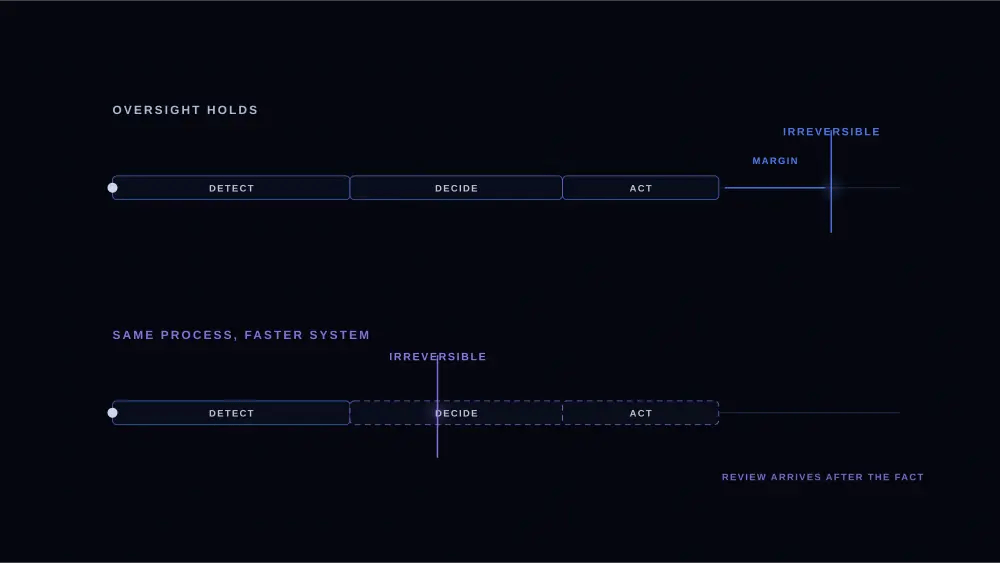
“Human in the loop” appears in procurement requirements, regulatory filings and internal risk registers as though it were a control. Usually it denotes a person, a screen, and an approve button — an arrangement that provides almost none of the assurance being placed on it.
The phrase describes a position in a workflow. It says nothing about whether the person in that position can detect a problem, has the authority to act on it, or has enough time to act before the action becomes permanent. Those are the properties that make oversight real, and none of them are implied by the presence of a reviewer. The regulatory environment is now specific enough that the gap between the two matters commercially as well as operationally: an organisation that has documented human oversight it cannot demonstrate has manufactured evidence against itself.
The failure mode is old and well documented
Automation research has a long-standing finding: a human supervising an automated system that is usually right becomes progressively worse at catching the times it is wrong.
The mechanism is structural, not attitudinal. A reviewer approving decisions that are correct 95% of the time learns, correctly, that the system is usually right. That learned expectation is what makes the remaining 5% hard to see — the reviewer is no longer reading each case fresh, they are confirming a prior. The better the system gets, the stronger the prior and the weaker the review. Oversight quality degrades as system quality improves, which is exactly backwards from how it is planned.
The errors also cluster. Systems fail disproportionately on unusual inputs — precisely the cases where the reviewer has least context and the system’s confident output is most persuasive.
Oversight has a latency budget
The three conditions below are necessary. But there is a prior constraint that is almost never written down, and it determines whether the conditions can be met at all.
For an intervention to be possible, the time to notice, decide and act must fit inside the time before the action becomes irreversible:
T(detect) + T(decide) + T(act) < T(irreversible)
Everything else is negotiation about the terms. This is the reason oversight tends to survive in credit adjudication and collapse in automated trading, payments and agentic tool use: not because the second group is less regulated, but because the right-hand side shrank to seconds while the left-hand side stayed human. A reviewer who receives the alert after the transfer has settled is not an overseer. They are an auditor, and the organisation should say so.
The budget has a practical use beyond diagnosis. It converts an unfalsifiable governance claim into an engineering measurement. Both sides can be instrumented: alert-to-acknowledgement time is observable, and time-to-irreversibility is a property of the system design. Where the inequality does not hold, there are only three honest remedies, and each is an architectural decision rather than a training exercise:
- Increase T(irreversible) — insert a settlement delay, a hold period, a staged commit. This is the most common fix and the most often refused, because it costs latency the business does not want to spend.
- Reduce T(detect) — surface the case before the action, on the system’s own uncertainty, rather than alerting after execution.
- Remove the human and bound the action instead — if the timeline cannot accommodate a person, place the decision behind deterministic authorization with limits that hold without one.
The fourth option — keeping the reviewer and accepting that they cannot arrive in time — is the one most systems have chosen by default, without anyone choosing it.
Three conditions
Given a workable latency budget, three further things must hold. They are not a maturity ladder; missing any one voids the others.
1. The reviewer can reconstruct the decision. Not “sees the output” — can work out why. That means the inputs the system used, the intermediate steps, and what it was uncertain about. A screen showing a conclusion and two buttons offers nothing to reason from, so the only available strategies are trust it or block everything. This is why traceability is an oversight requirement before it is a compliance one: the logging that lets an engineer debug a bad decision at 3am is the logging that lets a reviewer evaluate one at 3pm.
2. The volume fits the available attention. A reviewer handling forty approvals an hour is not reviewing. The fix is not more discipline; it is fewer items. A system that escalates 2% of cases with real review is meaningfully safer than one escalating 40% with none, even though the second looks far more cautious in a policy document.
3. Disagreement is survivable. If declining is slow, unrewarded, or treated as obstruction, the gate is decorative. This is organisational rather than technical, and it is the condition most often absent — partly because it is the only one that cannot be fixed by shipping something. Ask directly: when did a reviewer last override this system, and what happened to them afterwards? An oversight process with no overrides on record is not evidence of a well-calibrated system. It is evidence that nobody is exercising the process.
What the frameworks actually require
Two instruments from different legal traditions converge here, which is worth noticing because they arrive from opposite directions.
The EU AI Act. Article 14 requires that high-risk systems be designed so that they can be effectively overseen by natural persons — including that overseers can understand the system’s capacities and limitations, remain aware of automation bias, interpret output correctly, and decide not to use the system or to override it. That is conditions 1 and 3, written into binding law.
Current status (fact, as of September 2026): the Digital Omnibus on AI, Regulation (EU) 2026/1744, was published in the Official Journal on 24 July 2026 and entered into force on 27 July 2026. It defers the compliance deadline for stand-alone Annex III high-risk systems from 2 August 2026 to 2 December 2027, and for high-risk systems embedded in regulated products under Annex I to 2 August 2028. Article 50 transparency obligations and general-purpose AI model obligations remain on the 2 August 2026 schedule.
Interpretation, not fact: what moved was the date, not the design requirement. The Omnibus is a deferral and simplification instrument; it did not rewrite what effective oversight means. Organisations reading the delay as relief are mispricing it — the obligations are unchanged, the systems being built now will still be in production in December 2027, and oversight is one of the few requirements that is genuinely expensive to retrofit, because it constrains throughput and interface design rather than adding a document.
NIST’s AI Risk Management Framework (AI 100-1) is voluntary and binds nobody. It arrives at the same place through its Govern and Measure functions: accountable roles with real authority, and measurement that actually feeds decisions. The Generative AI Profile (AI 600-1) extends the same core to generative-AI-specific risks.
When a binding regulation and a voluntary framework independently land on the same requirement, that requirement is probably not a compliance artifact. It is a description of what has to be true for the thing to work.
Design consequences
Escalate on uncertainty, not on category. Routing every transaction over $10,000 to review means most escalations are routine large transactions, and the reviewer learns to approve quickly. Routing cases the system is genuinely unsure about produces a queue where attention is warranted — and where the reviewer’s prior is not “this will be fine.”
Show the working, not the verdict. The reviewer needs the inputs, the path taken, and the competing options considered. That costs interface work which approve/reject does not, and it is the difference between review and ratification.
Make disagreement cheap. A one-click escalation with no friction gets used. A form requiring written justification does not, and its absence will later be read as agreement.
Instrument the oversight itself. Track approval rate, time-per-decision and override frequency. An approval rate near 100% at four seconds per decision tells you the gate is not functioning, and it tells you long before an incident does.
Treat the kill switch as a system, not a control. A stop button is only meaningful if someone is watching the right signal, has authority to press it without escalation, and the system stops in a recoverable state rather than mid-transaction. Most kill switches fail on the third condition: halting an agent between its action and its record of that action leaves the organisation unable to say what happened — which is why containment and bounded, observable and recoverable failure are the same engineering problem. A stop that produces an unknown state has traded an incident for an investigation.
The uncomfortable part
Real oversight is expensive. It requires interface work, lower throughput, staff with genuine authority, and acceptance that a meaningful fraction of decisions get slower.
Teams that say “human in the loop” and mean an approve button have not chosen oversight. They have chosen its appearance at nearly none of the cost — and the appearance is worse than nothing, because it manufactures a record of human review that everyone downstream relies on. Auditors, regulators, customers and the team itself reason as though a person checked. Given the reliability arithmetic of long agent chains, the cases where nobody meaningfully checked are not rare.
The honest options are to build oversight that functions, or to reduce the consequence until the decision does not need a human at all. Both are defensible, and the second is frequently the better engineering answer. What is not defensible is a gate that produces the documentation of care without the substance of it. The latency budget is the fastest way to find out which one you have: measure how long your reviewer takes, measure how long your system gives them, and compare the two numbers. Most organisations have never put them on the same page.

