
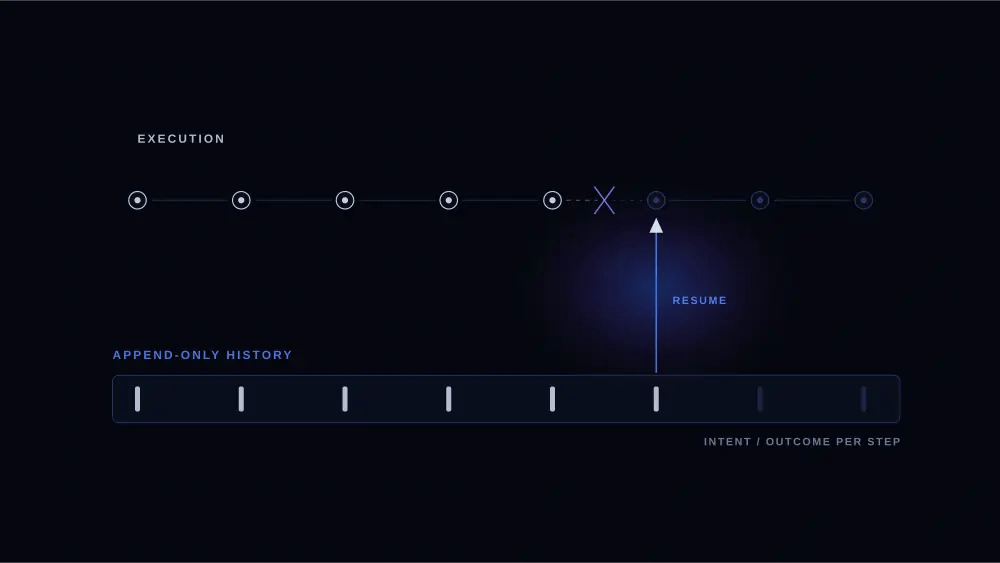
An agent thirty steps into a forty-step task hits a timeout. The obvious fix is to retry. The obvious fix is also how you send the same invoice twice.
That gap — between a system that usually works and a system that can be operated — is the whole distance between a prototype and a production deployment, and it is not crossed by improving the model. It is crossed by making failure bounded (the damage has a known ceiling), observable (you can determine what happened), and recoverable (there is a defined path back to a correct state). None of the three can be retrofitted cheaply, because each constrains how the system is structured rather than what it does.
This matters more for agents than for conventional software for a specific reason. Deterministic services fail in ways their authors enumerated. An agent composes its own execution path at runtime, so the set of possible failures is not fully known in advance — which means recovery cannot be a list of handled cases. It has to be a property of the architecture.
Classify side effects before anything else
Every step an agent takes falls into one of four categories, and the category determines what recovery is even possible.
Pure. Reading a file, computing a total, classifying a document. No external state changes. Retry is free and unconditional. Most reasoning lives here, which is why the arithmetic of retrying reasoning is comfortable and the arithmetic of retrying actions is not.
Idempotent. Setting a record’s status to approved; writing a specific value to a specific key. Running it twice produces the same state as running it once. Retry is safe, though it still costs time and tokens.
Compensatable. Creating a draft, reserving inventory, opening a ticket. The effect is real but a defined inverse exists. Retry is safe only if the compensation actually runs — which requires knowing the first attempt happened.
Irreversible. Sending an email, executing a payment, deleting a production record. There is no inverse. A retry here is not recovery; it is a second, independent event in the world.
Most teams discover this taxonomy in production, because agent frameworks present every step as a uniform “tool call” — and uniformity is precisely the wrong abstraction for operations whose recovery semantics differ this much. The first concrete deliverable of a production hardening effort is a table mapping every tool the agent can reach to one of these four categories. It is tedious, it requires knowing what your tools actually do, and it is the artifact everything else depends on.
Idempotency keys, and the part that goes wrong
For the second and third categories the standard mechanism is an idempotency key: a caller-generated identifier the receiver uses to deduplicate. The mechanism is well understood. What breaks in agent systems is key derivation.
The key must be deterministic with respect to intent and stable across retries. Generate it from a random UUID at call time and every retry produces a new key, so it deduplicates nothing — ceremony without protection. Derive it from a hash of the request payload and you are safer, until the payload contains a timestamp or a model-generated field that differs by a token between attempts, at which point you are back to a fresh key each time.
The reliable derivation is from the task, not the request: {task_id}:{step_index}:{logical_operation}. That identifier is stable across attempts because it describes which step of which task this is, which does not change when the model rephrases itself. A system with keys that vary across retries has all of the complexity and none of the protection, and it looks correct right up until the first real failure.
Write the intent before the effect
If you perform an action and then record it, a crash in between leaves an effect nobody knows about. On resume the system sees no record and does it again.
The fix is the one databases have used for decades — write ahead:
- Record the intent: “about to run step 17 with key
task-4:17:send-invoice” - Perform the effect
- Record the outcome
A crash now lands in one of two recoverable places, and both resolve through the same path: an intent with no outcome means the step may have run, and the idempotency key makes re-running it safe. Collapsing two failure modes into one resumption path matters more than it sounds, because it is the path that gets exercised often enough to actually work.
The uncomfortable implication is that “intent with no outcome” is genuinely ambiguous. The system cannot distinguish never ran from ran and we lost the acknowledgement. That ambiguity does not disappear; it gets handled — by idempotency where the step allows it, by reconciliation against the external system where it does not, and by a human where neither is possible. Any design claiming to eliminate it is hiding it.
Replay is not re-execution — and for agents that distinction is decisive
Durable execution engines take the write-ahead idea to its conclusion. Rather than persisting current state, they record an append-only history of events — every activity invocation, timer and signal — and reconstruct a crashed workflow by replaying that history deterministically. Temporal is the widely used implementation of this model; the requirement it imposes is that workflow code must be deterministic, so that replaying the same history yields the same execution.
An LLM call is not deterministic. This is where teams get the architecture wrong, and the correction is precise:
The model call must be recorded as an activity whose result is a fact in the history — never as logic re-evaluated during replay.
Put the model inside deterministic workflow code and every recovery re-samples the model, producing a different plan than the one the system already acted on. The result is worse than a crash: a system that resumes into a different task while believing it continued the original one. Record the model’s output as an event and replay reads it back as history, so the recovered execution is the one that actually happened.
This yields a clean architectural rule. Deterministic orchestration code holds the control flow; every non-deterministic thing — model calls, tool invocations, clock reads, randomness — is an activity with a recorded result. It is also the answer to the perennial objection that durable execution and dynamic agents are incompatible. They are not. What is incompatible is putting non-determinism in the layer whose entire contract is determinism.
What belongs in the record
Two failure modes, in opposite directions.
Record too little and resumption is a fiction: the agent restarts, lacks the context that shaped steps 1 through 16, and makes a different decision at step 17 than it would have. The task technically continues and quietly becomes a different task.
Record everything — every full conversation, every intermediate result — and state grows without bound, resumption becomes slower than restarting, and you have built an expensive way to store transcripts.
The useful line is between derived and load-bearing state. Load-bearing state is anything a later step depends on: extracted values, decisions made, external identifiers returned by prior calls, and the assembled context that produced a decision. Derived state is anything reconstructible from it. Record the first, recompute the second.
The audit trail and the recovery log are the same artifact
This is the part with the strongest organisational consequence, and it is usually missed because the two requirements arrive from different departments.
The append-only history that makes recovery possible — every input, decision, action and result, in order, with the model outputs that produced them — is also precisely the evidence an auditor, a regulator or an incident review needs. Built once, it satisfies both. Built separately, you get a recovery mechanism engineers trust and an audit log nobody does, because the second is assembled after the fact from whatever happened to be logged.
The traceability expectations in frameworks such as the NIST AI Risk Management Framework are, at an engineering level, requests for exactly this record. Teams that treat compliance logging as a tax build it twice and get the worse version of both. Teams that recognise the artifact is shared build it once, for operational reasons they already believe in, and find the governance requirement mostly satisfied as a side effect.
It is also the precondition for stopping safely. A kill switch that halts an agent between its action and its record of that action produces an unknown state; the same durable history is what makes a stop that leaves a known state possible.
Irreversibility is a design problem, not an error-handling problem
Nothing above helps with the fourth category. If a step moves money and the acknowledgement is lost, no key and no log tells you whether the money moved. You have to ask the external system — and if it cannot tell you either, you have to ask a person.
Three consequences follow, and they are architectural.
Order for a single ambiguous window. A workflow that performs all reversible work, records, and then executes the single irreversible action has one ambiguous window instead of one per step.
Make the external system the source of truth on resume. Query whether the effect happened rather than trusting local state. Local state is what you just lost.
Where neither is possible, gate it. A confirmation before an irreversible action is not a failure of autonomy; it is the correct response to a step whose failure mode cannot be resolved by machinery.
In financial contexts these stop being engineering preferences. Reconciliation against the ledger of record, exactly-once settlement semantics, and a reconstructable decision history are the ordinary expectations of the domain, and an agent that cannot meet them is not deployable there regardless of how well it reasons.
What this changes
The reframing is the practical answer to the compounding arithmetic of multi-step tasks. A system that records, verifies and resumes is not running one forty-step task with forty chances to fail irrecoverably. It is running a sequence of short segments with defined recovery between them, and the exponent that makes long chains hopeless applies to the segments rather than to the whole trajectory.
That reframing costs something real: it is materially more infrastructure than calling the model in a loop, and it forces the side-effect classification that most teams would rather skip. What it buys is the ability to enumerate your failure modes — which is the difference between a system you can put in front of consequences and a demonstration.
The strategic version, for anyone deciding where to spend: model capability determines how often the system is right, and recoverability determines what it costs when it is wrong. Only the second is under your control, and only the second compounds into an operational asset. A production AI programme that has not answered “how do we find out what happened, and how do we get back to a correct state” has not begun the production work, however well the prototype demonstrates.

